
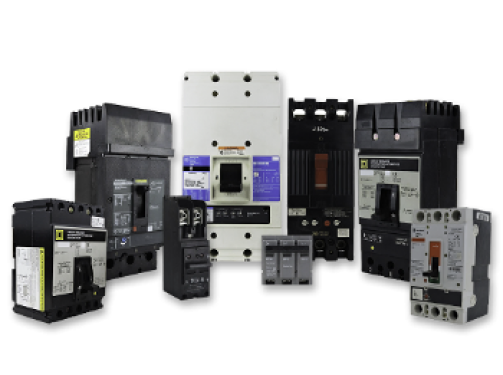
Surplus Circuit Breaker Buyers for Excess Electrical Inventory
Call or text 713-385-1333 to request a direct review of available breakers.
Qualified surplus circuit breaker buyers help businesses turn unneeded breaker inventory into a direct sales opportunity. Texas Global Resources reviews selected new, unused, used, obsolete, and project-surplus circuit breakers from verified owners throughout the United States. Electrical contractors, industrial plants, commercial property operators, construction companies, distributors, maintenance departments, and warehouses can submit individual breakers, matching groups, palletized lots, or broader facility inventories.
Breakers become surplus for many reasons. A project specification may change after equipment is ordered, an electrical service may be upgraded, a facility may standardize around another manufacturer, or a plant may retire the switchgear supported by its spare inventory. The reason an item became available helps explain its history, but the purchase review still depends on its exact catalog information and present condition.
Texas Global Resources evaluates manufacturer, series, model, frame, trip rating, voltage, poles, interrupting capacity, trip unit, mounting, accessories, quantity, condition, testing, demand, location, and logistics. To contact surplus circuit breaker buyers, call or text 713-385-1333 or send information through the Texas Global Resources contact form.
What Surplus Circuit Breaker Buyers Purchase
Surplus breaker inventory can include compact molded-case units, larger insulated-case breakers, draw-out breakers, air circuit breakers, electronic trip systems, replacement spares, and associated hardware. A useful submission identifies each product at the catalog-number level rather than grouping everything under a broad amperage description.
Information that supports the review includes:
- Manufacturer, product family, series, type, and catalog number
- Frame, continuous-current rating, sensor, and rating plug
- Voltage, poles, frequency when applicable, and interrupting rating
- Thermal-magnetic or electronic trip configuration
- Fixed, bolt-on, plug-in, or draw-out construction
- Lugs, stabs, primary disconnects, and terminal arrangement
- Shunt trips, motor operators, auxiliary contacts, and accessories
- Packaging, installation history, testing status, and physical condition
Surplus circuit breaker buyers cannot responsibly value equipment from appearance alone. Complete labels, readable ratings, honest condition notes, and accurate quantities are essential. Not every submitted breaker will qualify for purchase because specifications, condition, demand, location, and transportation still control commercial feasibility.
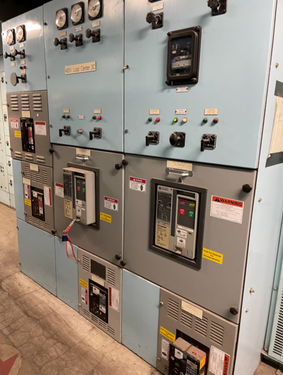
Surplus Circuit Breaker Buyers for Switchgear Breakers
Call or text 713-385-1333 with breaker and switchgear identification.
Breakers associated with switchgear should be documented before removal. Photograph the full lineup, manufacturer plate, series, voltage, amperage, section number, cell, breaker type, frame, trip unit, control voltage, and protective components. This context helps explain how each breaker was configured without implying that it is approved for another installation.
If the breakers are removed, label each unit to its original section. Preserve racking handles, secondary plugs, extension rails, cradles, interlocks, control components, drawings, manuals, and matching hardware. A complete relationship between the breaker and its cell is more useful than unrelated parts stored in separate areas.
Before surplus circuit breaker buyers review installed equipment, the owner must arrange de-energization, lockout, verification, disconnection, and safe access through qualified personnel. A purchasing review is not permission to work on energized electrical systems.
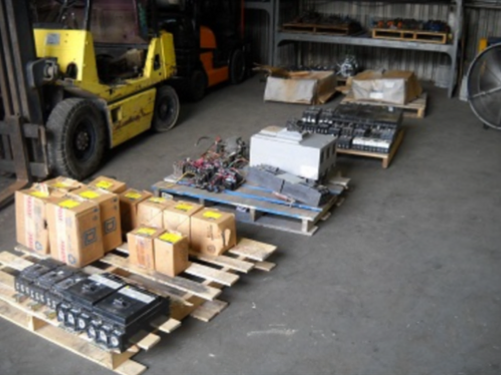
Surplus Circuit Breaker Buyers for Palletized Inventory
Discuss breaker pallets, storage access, and pickup deadlines at 713-385-1333.
Palletized inventory should be counted and labeled before an offer is finalized. Assign a unique number to each pallet, create a list of models and quantities, and connect photographs to the correct location. Wide images should show the overall storage arrangement, while detailed images should make catalog labels readable.
Separate breakers from unrelated electrical parts, empty cartons, scrap, and unidentified material. Within each pallet, distinguish new in box, opened box, loose unused, previously installed, rebuilt, untested, damaged, and incomplete units. Do not hide damaged equipment underneath cleaner inventory.
Logistics matter to surplus circuit breaker buyers. Provide pallet dimensions, estimated weight, forklift availability, dock height, trailer access, security procedures, appointment requirements, daily working hours, and the final pickup date. A well-organized warehouse can shorten loading time and reduce mistakes.
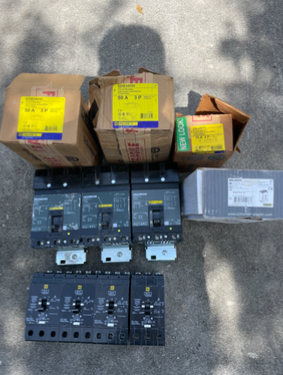
Surplus Circuit Breaker Buyers for Boxed Breakers
Submit boxed project overages and spare breakers at 713-385-1333.
Boxed breakers often become surplus after a design revision, cancelled project, excess order, specification change, or inventory consolidation. Original packaging can support product identification and storage history, but sellers should verify that the breaker inside matches the label on the box.
Photograph the carton label, factory seal, internal packaging, actual breaker label, terminals, trip unit, and included accessories. Disclose opened cartons, shelf wear, moisture, crushed boxes, missing hardware, broken seals, handwritten model changes, and packaging that contains a different unit.
Surplus circuit breaker buyers need accurate condition language. “New in box” should be reserved for equipment that is genuinely new and correctly packaged. An installed breaker returned to a box should be described as used, even if the carton appears clean.
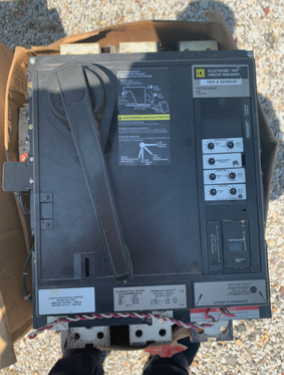
Surplus Circuit Breaker Buyers for Large Molded-Case Breakers
Send frame, trip, voltage, mounting, connection, and accessory details after calling 713-385-1333.
Larger molded-case and insulated-case breakers may use interchangeable trip units, rating plugs, sensors, motor operators, shunt trips, undervoltage releases, and auxiliary contacts. A frame designation does not identify every installed component. Photograph the main breaker label and each separate protection or accessory label.
Document rear connections, lugs, plug-in hardware, mounting brackets, terminal covers, interlocks, and included parts. If the breaker came from a panelboard or switchboard, provide the original equipment manufacturer and series. Keep removed mounting hardware and connectors with the correct breaker.
Surplus circuit breaker buyers also examine visible condition. Disclose cracked cases, burned areas, damaged terminals, stripped bolts, broken handles, missing covers, corrosion, contamination, altered wiring, or a trip unit that does not power. Do not use cosmetic work to hide damage.
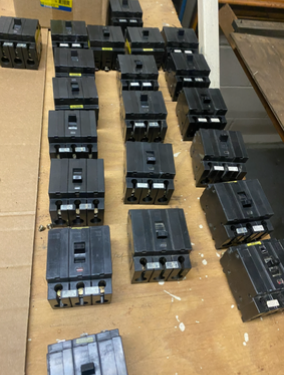
Surplus Circuit Breaker Buyers for Organized Mixed Lots
Call 713-385-1333 with a catalog-level list of mixed breakers.
Mixed lots should be organized by exact catalog number rather than appearance. Breakers with similar case sizes may differ in trip rating, voltage, poles, interrupting capacity, mounting, or protection. Create separate counts for each model and condition category.
Photograph the entire group, then provide readable labels and rear views for representative units. If a lot includes several manufacturers, separate them physically when practical. Assign shelf, table, row, or container numbers so the buyer can match images to the inventory.
For surplus circuit breaker buyers, organization reduces uncertainty. It also prevents a small number of specialty breakers from being overlooked within a general count of common or low-value units.
Surplus Breaker Conditions That Affect a Purchase
New in Original Packaging
Factory labels, seals, internal packaging, accessories, and protected storage help support the claim. The seller should still verify model identity and disclose packaging damage.
Unused Without Packaging
A breaker may be unused even when the carton is missing, but storage and handling must be considered. Photograph the complete unit and explain how its history is known.
Removed From Service
State why removal occurred, whether it was part of a planned upgrade, and whether a fault or failure was involved. Prior operation does not equal current testing.
Rebuilt or Reconditioned
Identify the service provider, date, replaced parts, procedures, and test documentation. Avoid rebuild claims that cannot be supported by records.
Untested
Untested is an appropriate disclosure when no current report exists. Handle movement, visual inspection, or prior energization is not a complete electrical test.
Damaged or Incomplete
List cracks, burns, corrosion, damaged contacts, broken handles, missing trip units, absent rating plugs, incomplete cradles, stripped hardware, and contamination.
Why Businesses Contact Surplus Circuit Breaker Buyers
Direct review gives equipment a chance to be evaluated for its design, ratings, compatibility, availability, and demand before it is treated only as scrap. Scrap may remain the correct route for unsafe or unmarketable units, but it should not automatically define every complete breaker.
Businesses also contact surplus circuit breaker buyers to reduce the labor of individual sales. Researching, listing, answering questions, processing payments, packing, and shipping one breaker at a time can consume significant staff time. A direct purchase may combine accepted equipment into one written transaction.
Common triggers include electrical upgrades, construction closeouts, cancelled projects, spare-parts reductions, warehouse consolidations, distributor inventory changes, plant shutdowns, and property deadlines. Early contact preserves labels, accessories, testing records, and condition information.
How the Surplus Circuit Breaker Buyers Process Works
1. Provide an Initial Inventory View
Send several clear labels, representative photographs, manufacturers, approximate quantities, condition, location, and deadline. This determines whether a detailed review is justified.
2. Build an Accurate Breaker Schedule
List complete catalog numbers, frames, trip ratings, voltage, poles, interrupting ratings, trip units, mounting, accessories, condition, and quantity. Match photographs to every important line.
3. Confirm Ownership and Site Requirements
The seller must have authority to transfer the breakers. Separate leased, financed, customer-owned, consigned, disputed, or excluded property. Disclose loading, security, insurance, and scheduling requirements.
4. Review the Offer
The written offer should identify accepted models and quantities, price, payment, packaging, loading, transportation, pickup timing, and exclusions. Correct discrepancies before approval.
5. Verify Payment and Coordinate Pickup
Texas Global Resources states that payment is provided before purchased breakers are loaded. Sellers should independently verify cleared funds and confirm the carrier, vehicle, and authorized pickup list.
How Surplus Circuit Breaker Buyers Determine Offers
Manufacturer and Exact Model
Complete catalog numbers allow the buyer to research compatibility and current demand. Abbreviated descriptions or missing suffixes may identify the wrong product.
Electrical Ratings and Configuration
Frame, amperage, voltage, poles, interrupting rating, trip functions, mounting, terminals, and accessories define the actual breaker.
Condition and Completeness
Packaging, installation history, storage, damage, missing components, alteration, and contamination affect commercial potential.
Testing and Records
Dated reports should match the breaker. Testing performed on another unit or years earlier should not be represented as current evidence for the submitted equipment.
Quantity and Organization
Matching, well-documented groups can be easier to inspect, package, and transport. Mixed unidentified material requires more sorting and carries greater uncertainty.
Demand and Obsolescence
Some older breakers retain demand because compatible equipment remains installed. Others have limited demand because of replacement availability, codes, technology, or parts support.
Preparation Checklist for Surplus Circuit Breaker Buyers
- Sort breakers by manufacturer, series, and complete catalog number.
- Separate new, unused, used, rebuilt, untested, damaged, and incomplete units.
- Photograph front labels, side labels, trip units, terminals, and mounting.
- Keep cradles, plugs, lugs, handles, hardware, and accessories together.
- Preserve original cartons, manuals, drawings, and testing records.
- Protect breakers from moisture, impact, dust, and contamination.
- Identify excluded, leased, financed, or third-party-owned equipment.
- Use qualified personnel to remove breakers from electrical systems.
- Provide pallet, forklift, dock, gate, and deadline information.
- Verify payment before releasing accepted inventory.
Why Choose Texas Global Resources as Surplus Circuit Breaker Buyers?
Texas Global Resources offers a direct purchasing option for businesses with excess breaker inventory. Its stated process includes equipment review, offers for accepted units, transportation coordination, and payment before loading. Sellers can submit individual breakers, matching groups, or facility-scale inventories.
The company is based in South Houston, Texas and reviews opportunities from across the United States. Purchase feasibility depends on breaker identity, ratings, condition, quantity, demand, location, access, and transportation. Learn more on the Texas Global Resources About page.
Businesses comparing surplus circuit breaker buyers should look for exact inventory documentation, written commercial terms, honest condition language, clear logistics, and a verifiable payment process. Texas Global Resources bases its review on the submitted equipment rather than generic promises.
Surplus Circuit Breaker Buyers: Seller Questions
Can one surplus breaker be submitted?
Yes. One significant breaker can be reviewed. Feasibility depends on manufacturer, model, ratings, condition, demand, location, and transportation.
Can used and obsolete breakers be included?
Yes. Used and obsolete units can be submitted, but exact catalog information and honest condition details are essential because demand varies by model.
Must breakers have current testing?
Not necessarily. Untested equipment may be considered when the limitation is disclosed. Previous operation is not a current electrical test.
Can incomplete units be submitted?
Incomplete or damaged breakers can be identified, but missing trip units, rating plugs, cradles, contacts, or hardware may reduce marketability.
Who coordinates transportation?
Texas Global Resources states that it coordinates transportation for purchased breakers. The agreement should define packaging, palletizing, loading, and pickup responsibilities.
When does the seller receive payment?
The company states that sellers are paid before accepted equipment is loaded. Confirm the method and independently verify cleared funds.
Request an Offer From Surplus Circuit Breaker Buyers
Surplus breaker inventory should be documented while labels, packaging, accessories, and records remain available. Waiting can lead to moisture damage, mixed models, missing parts, and a rushed removal schedule.
To request an offer from surplus circuit breaker buyers, send clear photographs, manufacturer and catalog information, ratings, trip-unit details, mounting, quantities, condition, testing status, pickup location, access, and the desired schedule.
Call or text 713-385-1333 to contact surplus circuit breaker buyers, or submit your breaker inventory online.