
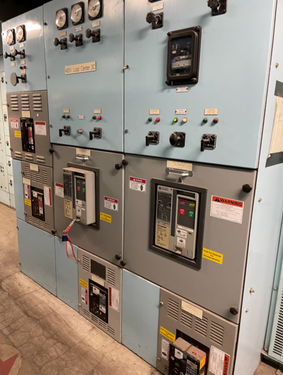
Motor Control Center Buyers for Industrial Electrical Equipment
Call or text 713-385-1333 to submit an MCC lineup, bucket inventory, or facility-removal opportunity for review.
Motor control center buyers provide industrial equipment owners with a direct way to present complete MCC lineups, individual sections, replacement buckets, starters, disconnects, and related controls for a commercial purchasing review. Texas Global Resources evaluates qualified equipment from verified businesses across the United States, including manufacturers, plants, electrical contractors, distributors, commercial facilities, project managers, demolition firms, and companies completing upgrades or shutdowns.
A motor control center is not accurately described by cabinet dimensions alone. Manufacturer, series, voltage, bus rating, short-circuit rating, enclosure, section count, starter sizes, feeder devices, control voltage, bucket configuration, documentation, condition, location, and removal status can all affect purchasing interest. Sellers contacting motor control center buyers should provide clear lineup photographs, readable identification labels, and an inventory of the installed units.
Texas Global Resources is an equipment purchasing company, not an engineering, testing, installation, energization, code-compliance, or safety-certification provider. MCC equipment can contain hazardous voltage, stored energy, sharp metal, substantial weight, and arc-flash risks. Only qualified personnel should inspect energized areas, establish an electrically safe work condition, disconnect conductors, remove sections, operate lifting equipment, or prepare a lineup for shipment.
What Motor Control Center Buyers Review
Qualified opportunities can include low-voltage motor control centers, medium-voltage motor control equipment, combination starter lineups, feeder sections, main disconnect sections, variable-frequency-drive sections, soft-starter sections, reduced-voltage starters, lighting or distribution sections incorporated into an MCC, and compatible replacement buckets. Purchasing interest depends on the exact equipment, current demand, completeness, condition, documentation, and recovery requirements.
Both complete lineups and partial inventories may warrant consideration. A complete lineup can be attractive when its bus, vertical sections, doors, buckets, hardware, and documentation remain together. Individual buckets or components may be useful when they match an installed equipment family. Loose parts without manufacturer identification or reliable compatibility information are more difficult to assess and should be separated from confirmed inventory.
Motor control center buyers need an honest condition category for every submission. Identify equipment as new surplus, unused project inventory, installed but never energized, operational when removed, tested after removal, stored, rebuilt, damaged, incomplete, or condition unknown. Avoid describing a unit as working unless records or qualified observations support that statement. Photographs should show defects rather than concealing them.
Older and discontinued MCCs may still receive attention when their exact series and configuration support existing facilities. Age alone does not establish value. Obsolete equipment with complete labels, sound enclosures, identifiable buckets, and useful components can have more commercial potential than newer equipment that is damaged, undocumented, altered, or costly to recover.
Complete MCC Lineups
For a complete lineup, record the total number of vertical sections, overall width and height, approximate depth, bus rating, voltage, main-device information, enclosure type, and lineup arrangement. Photograph the equipment from end to end with all doors closed, then document each section label and each safely accessible bucket face. Include drawings or schedules when they accurately match the current configuration.
MCC Buckets, Starters, and Feeder Units
For individual buckets, record manufacturer, product family, bucket size, starter type, NEMA or IEC rating, horsepower where documented, voltage, disconnect or breaker information, overload type, control transformer data, control voltage, and included pilot devices. State whether stab assemblies, doors, hardware, terminal blocks, and interlocks remain attached. Motor control center buyers must know whether a bucket is complete or being offered for parts.
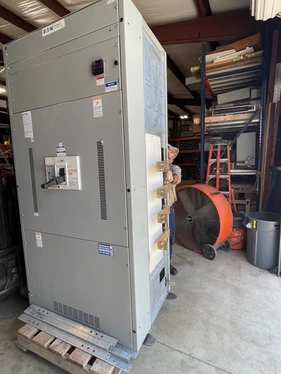
Motor Control Center Buyers Need Clear Equipment Identification
Have a complete cabinet or multi-section lineup? Call 713-385-1333 with the manufacturer, series, voltage, and location.
Begin with the master nameplate or lineup label. Capture the manufacturer name, equipment designation, catalog or order number, manufacturing date when present, voltage, phase, frequency, horizontal bus rating, vertical bus rating, short-circuit current rating, enclosure classification, and any factory drawing references. Take the photograph straight on, in focus, and close enough for every character to be readable.
Next, identify each vertical section in order from left to right. A simple numbered sketch can connect the photographs to the actual lineup. Note main breakers, main switches, tie devices, feeder breakers, fused switches, starter buckets, drives, soft starters, power-factor-correction components, metering, programmable controls, and spare spaces. This organization allows motor control center buyers to understand what is included without guessing from distant photographs.
Manufacturer and series compatibility are especially important. Equipment that looks similar may use different bus stab designs, bucket widths, interlocks, hardware, door arrangements, or control schemes. Never claim interchangeability based only on appearance. Provide exact labels and, when available, manufacturer documentation that identifies the product family and factory configuration.
Alterations should be disclosed. Field-installed drives, modified doors, replaced breakers, changed control transformers, bypassed interlocks, added ventilation, drilled enclosures, missing barriers, and non-factory wiring may affect a review. Show the modification clearly and state whether drawings were updated. A transparent submission helps purchasing personnel distinguish factory construction from later changes.
Why Companies Contact Motor Control Center Buyers
MCC equipment becomes surplus for practical business reasons. A production line may be retooled, a facility may change voltage, a plant may standardize on another manufacturer, a construction project may be cancelled, or an expansion may leave unopened sections and spare buckets. A site closure can release an entire electrical room, while a maintenance department may discover duplicate components that no longer support active equipment.
Leaving surplus MCC sections in place can consume valuable electrical-room space and complicate an upcoming project. Moving removed equipment repeatedly can damage doors, bus, stabs, handles, meters, and sheet metal. Motor control center buyers can review qualified assets while identifiers, drawings, bucket schedules, and service history are still available, helping the owner make an informed disposition decision before components become separated.
A direct purchasing inquiry also gives maintenance, engineering, procurement, accounting, and facility teams one organized process. Engineering may hold one-line diagrams, maintenance may know operating history, accounting may control asset release, and the warehouse may understand loading access. Combining those details into one accurate submission reduces avoidable questions and conflicting descriptions.
No purchasing review guarantees an offer. Demand may be limited by an uncommon voltage, proprietary design, severe damage, missing buckets, altered bus, incomplete ownership documentation, restricted access, or recovery costs. Professional motor control center buyers should evaluate the actual facts before discussing price, pickup, or payment instead of making unsupported promises from a single photograph.
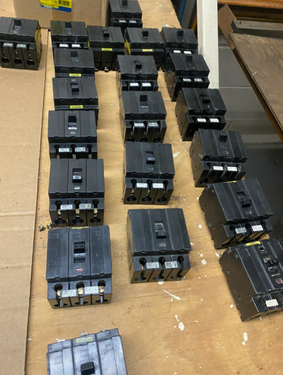
Motor Control Center Buyers for Buckets and Feeder Components
To submit buckets, starters, or feeder devices, call or text 713-385-1333 with labels and quantity photographs.
Loose bucket and feeder inventories require disciplined identification. Arrange units so the fronts, sides, labels, stab assemblies, and included hardware can be documented without unsafe handling. Group only truly matching catalog numbers together. A mixed pallet may contain different frame sizes, trip ratings, starter types, control voltages, or mounting arrangements even when the devices share a manufacturer.
For starter buckets, identify the contactor, overload relay, disconnecting means, fuse clips or breaker, control transformer, selector switches, indicating lights, auxiliary contacts, terminal blocks, and any network or automation modules. Report missing components and damaged wiring. Motor control center buyers can assess a complete bucket more effectively when every material component is shown in current photographs.
For feeder units, capture the breaker or fused-switch catalog number, frame rating, trip rating, pole count, interrupting rating where marked, fuse class, handle mechanism, door, and stab assembly. If the breaker has an electronic trip unit, photograph its model and settings without changing them. Do not operate, reset, disassemble, or test a device simply to prepare a sales inquiry.
Keep removed bucket parts together. Doors, mounting hardware, racking mechanisms, stab covers, terminal plugs, and control connectors can be essential to completeness. Use durable labels that connect each loose item to its bucket or section. Do not place heavy devices on delicate control components, and protect exposed stabs from impact during storage and transportation.
Information Motor Control Center Buyers Need
Manufacturer, Series, and Factory Order
Provide the exact manufacturer and product family from the equipment labels. Include factory order, drawing, or lineup numbers when present. These identifiers can help distinguish similar generations and configurations. If a label is missing or unreadable, say so and photograph the surrounding construction; do not copy an identifier from another section.
Voltage, Bus, and Short-Circuit Ratings
Record system voltage, phase, frequency, horizontal and vertical bus ratings, short-circuit rating, main-device rating, and neutral or ground-bus information when marked. Motor control center buyers use these facts to understand the lineup’s intended electrical application. Building records can be included, but the equipment nameplate should remain the primary identification source.
Section and Bucket Schedule
Create a section-by-section list describing every installed bucket and spare space. Include unit size, starter or feeder function, ratings, devices, and quantity. If an existing factory schedule no longer matches the lineup, mark the changes rather than presenting it as current. A spreadsheet or clearly formatted text inventory works well for a larger MCC.
Condition, Testing, and Removal Reason
Explain why the equipment became surplus and its last known operating status. Disclose overheating, arc damage, water exposure, smoke, corrosion, damaged bus, missing barriers, forced doors, broken handles, altered wiring, or removed components. If testing exists, provide the date, provider, methods, results, and equipment identifiers. A test sticker alone may not establish current condition.
Dimensions, Weight, and Site Access
Provide overall dimensions, section dimensions, documented weight when available, city and state, floor level, doorway measurements, stairs, elevators, dock access, lifting resources, loading hours, contractor requirements, and removal deadline. Motor control center buyers must consider safe recovery and transportation costs alongside equipment demand.
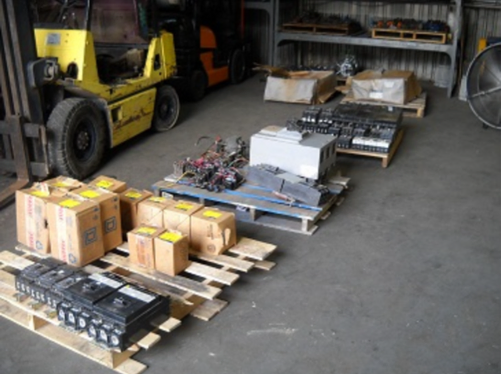
Motor Control Center Buyers for Warehouse and Project Inventory
For staged MCC assets or project overages, call 713-385-1333 with the inventory list and pickup location.
Warehouse inventory should be arranged by equipment family rather than described as one miscellaneous electrical lot. Keep complete MCC sections, buckets, starters, drives, feeder devices, doors, and loose accessories in separate inventory groups. Record quantities and catalog numbers for each group. Wide photographs can establish overall quantity, while detailed photographs confirm identity and condition.
Packaging offers useful context but does not prove condition. A factory carton may have been opened, moved, exposed to moisture, or paired with the wrong device. Photograph labels and visible packaging damage, state whether contents were inspected, and match every box to the inventory list. Motor control center buyers need accurate representations rather than assumptions based on packaging.
Palletized MCC sections must be stable, upright when required, and protected against damaged doors, protruding handles, and exposed bus. Describe whether the facility has a dock, forklift with adequate rated capacity, overhead crane, pallet jack, ground-level access, or loading appointment rules. Any lifting plan must be created and executed by qualified parties using reliable weight information.
For cancelled projects, provide available approved submittals, factory drawings, bills of material, bucket schedules, and purchase documentation. Remove confidential information unrelated to the equipment, but preserve technical details that establish configuration. Identify whether factory warranties or service agreements are transferable rather than promising that they accompany a sale.
How Motor Control Center Buyers Evaluate an Opportunity
There is no single price per section, bucket, amp, or horsepower that accurately values every MCC. Evaluation considers manufacturer, series, age, voltage, bus rating, short-circuit rating, lineup composition, starter and feeder mix, enclosure, condition, documentation, completeness, quantity, market demand, location, access, and recovery expense. Similar-looking lineups can therefore produce different commercial results.
Original project cost is not the same as current resale value. A highly customized lineup may have limited use beyond its original process, while standardized buckets from a widely installed series may support replacement demand. Conversely, common equipment can still have limited value when damaged, incomplete, obsolete without demand, or expensive to remove.
Complete documentation reduces uncertainty. One-line diagrams, factory drawings, MCC schedules, test reports, maintenance records, and photographs can show how the lineup was built and maintained. Documents should match the offered equipment. Mark superseded drawings and explain field changes so motor control center buyers do not mistake an original design for the present configuration.
Recovery conditions can determine whether a purchase is practical. A lineup located at ground level beside a loading area presents a different project from equipment in a basement electrical room with narrow doors and no lifting access. The purchasing discussion must clearly define responsibility for electrical disconnection, separation, rigging, packaging, loading, freight, site restoration, and scheduling.

Motor Control Center Buyers for Plant Upgrades and Shutdowns
Planning an electrical upgrade, line closure, or facility shutdown? Call 713-385-1333 before the MCC is dismantled.
Plant projects often involve controlled access, outage windows, contractor coordination, and fixed removal dates. Submit the opportunity early enough for equipment and logistics to be reviewed. State whether the MCC remains installed, has been de-energized by qualified personnel, is scheduled for removal, or is already staged. Never enter restricted electrical areas or open energized equipment to obtain photographs.
Explain the reason for release. Equipment retired because of process modernization has a different history from equipment removed after a fault, flood, fire, contamination event, or long period of abandonment. Disclose known incidents and provide relevant records. Motor control center buyers need the actual history to make a responsible commercial decision.
Before removal, preserve the lineup order. Number sections, doors, buckets, and loose hardware so the original arrangement can be reconstructed. Retain nameplates, labels, drawings, and factory schedules. Avoid cutting bus, cabinets, or structural members merely to speed extraction unless the agreed disposition expressly requires dismantling and qualified personnel have approved the method.
Define the schedule with separate dates for evaluation, offer acceptance, de-energization, disconnection, rigging, loading, and final site clearance. State security requirements, orientations, insurance requirements, work-hour restrictions, and site-specific contractor rules. Clear planning protects the facility schedule and prevents assumptions about services that were never included.
The Motor Control Center Selling Process
Confirm Legal Ownership
Verify that the organization owns the equipment or has written authority to sell it. Exclude leased, financed, utility-owned, customer-owned, consigned, or disputed assets. Separate approved surplus from active spares and equipment reserved for future maintenance.
Create an Accurate MCC Inventory
List the manufacturer, series, lineup ratings, section count, bucket schedule, condition, documentation, and included accessories. Pair the inventory with clear current photographs. Large opportunities should use consistent section and image numbers so every record can be traced to the correct equipment.
Describe Removal and Loading Conditions
Provide the equipment status, access route, dimensions, weight information, lifting resources, loading conditions, contractor requirements, city and state, and deadline. Do not promise that site labor or equipment will be available unless the responsible facility contact has confirmed it.
Submit the Opportunity
Send the organized information through the Texas Global Resources contact page or call the purchasing team. A complete submission allows motor control center buyers to identify missing details and determine whether the opportunity fits current purchasing requirements.
Confirm Commercial Terms
If purchasing interest exists, confirm the exact equipment, excluded assets, inspection expectations, price, payment timing, removal responsibilities, packaging, loading, freight, and deadline in writing. Do not release equipment until the authorized parties understand the agreed scope.
Frequently Asked Questions About Motor Control Center Buyers
Do Motor Control Center Buyers Purchase Complete Lineups?
Complete MCC lineups may be reviewed when they are identifiable, legally available, accurately represented, and aligned with current demand. Provide the manufacturer, series, ratings, section schedule, condition, documentation, location, access, and removal timeline.
Can Individual MCC Buckets Be Submitted?
Individual buckets, starters, feeder units, and compatible components may qualify. Photograph complete labels, devices, stabs, doors, and included hardware. Group matching catalog numbers and identify missing or altered components.
Are Obsolete Motor Control Centers Considered?
Some discontinued equipment can support installed systems, but obsolete status does not guarantee demand. Exact manufacturer and series identification, usable components, condition, completeness, quantity, and recovery cost all affect the review.
Can Equipment Be Reviewed Before a Scheduled Shutdown?
Yes. Early documentation can help determine potential purchasing interest before removal. Qualified site personnel must control access and safety. Never open, inspect, operate, or photograph energized compartments in violation of facility procedures.
Do Motor Control Center Buyers Arrange Pickup?
Pickup feasibility depends on equipment value, quantity, location, dimensions, weight, access, loading resources, project schedule, and site requirements. Any disconnection, separation, rigging, packaging, loading, or freight responsibility must be specifically confirmed in the commercial terms.
Can MCC Equipment Be Submitted From Anywhere in the United States?
Texas Global Resources reviews qualified industrial electrical opportunities across the United States. Location and recovery cost affect feasibility, so include the city and state, access conditions, and required removal date in the initial submission.
Contact Motor Control Center Buyers
Organized MCC information supports a faster and more credible review. Preserve labels and drawings, photograph each section, inventory every bucket, disclose modifications and damage, confirm ownership, and document the recovery route before equipment is dismantled or dispersed across multiple storage locations.
Texas Global Resources evaluates qualified motor control center opportunities according to exact identity, electrical ratings, configuration, condition, completeness, documentation, demand, quantity, location, schedule, and recovery requirements. The public-facing service is a commercial purchasing process for real equipment owners—not a substitute for engineering, testing, electrical contracting, environmental review, or safety services.
To reach motor control center buyers, submit the manufacturer, series, voltage, bus rating, short-circuit rating, section count, bucket schedule, condition, photographs, documents, dimensions, weight, city and state, access details, ownership confirmation, and desired timeline.
Call or text 713-385-1333 to contact motor control center buyers, or submit your MCC inventory online.