
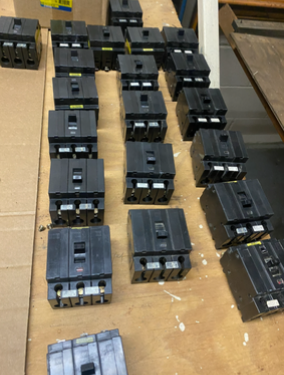
Sell Circuit Breakers Through a Direct Equipment Purchase
Call or text 713-385-1333 with breaker photographs, catalog numbers, ratings, quantities, and condition.
If your business needs to sell circuit breakers, Texas Global Resources provides a direct path for submitting new, used, unused, excess, and obsolete breaker inventory. Electrical contractors, industrial facilities, commercial property operators, construction companies, maintenance departments, distributors, and warehouse owners can present individual high-value units, matching groups, or larger mixed collections for review.
The breaker market depends on exact compatibility. Manufacturer, product family, catalog number, frame, trip rating, voltage, poles, interrupting capacity, trip unit, mounting, accessories, condition, testing, and quantity all influence whether a unit may fit another application. A general description such as “large industrial breaker” does not provide enough information for a responsible purchase decision.
Texas Global Resources evaluates the documented inventory, presents an offer for accepted equipment, coordinates transportation, and states that payment is provided before purchased breakers are loaded. To sell circuit breakers, call or text 713-385-1333 or use the Texas Global Resources contact form.
Information Needed to Sell Circuit Breakers
A strong submission lets the buyer identify each breaker without relying on assumptions. Photograph the front, rear, both sides, labels, trip unit, terminals, mounting points, included hardware, packaging, and visible defects. Images should be sharp enough to read the catalog number and ratings.
Record the following information when available:
- Manufacturer, series, model, and complete catalog number
- Frame size, amp rating, sensor, rating plug, and number of poles
- Voltage and interrupting ratings
- Thermal-magnetic or electronic trip configuration
- Fixed, draw-out, plug-in, or bolt-on mounting
- Lugs, stabs, primary disconnects, and rear connection style
- Shunt trip, undervoltage release, auxiliary contacts, and other accessories
- New, unused, installed, rebuilt, tested, untested, damaged, or incomplete condition
When you sell circuit breakers in quantity, group identical catalog numbers and count them separately. Do not combine similar housings under one description because ratings, trip units, interrupting capacities, and mounting configurations can differ.
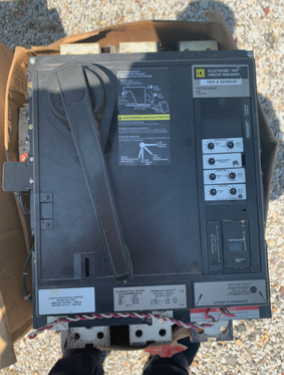
Sell Circuit Breakers in Molded-Case Configurations
Call or text 713-385-1333 to submit molded-case breaker inventory.
Molded-case breakers may look interchangeable while containing different frames, trip ratings, sensors, poles, interrupting ratings, lugs, and accessories. Capture the complete catalog number rather than identifying the unit only by handle amperage. If a side label contains suffixes or factory options, include it in the photographs.
Describe the breaker’s actual history. A unit in a clean box is not necessarily new, and a breaker removed from service is not necessarily tested. State whether packaging is original, whether the seals are intact, whether the equipment was installed, and whether current testing documentation exists.
Before you sell circuit breakers, keep terminal kits, plug-in bases, mounting hardware, auxiliary switches, shunt trips, and manuals with the correct units. Missing or mismatched components can reduce usability and slow identification.
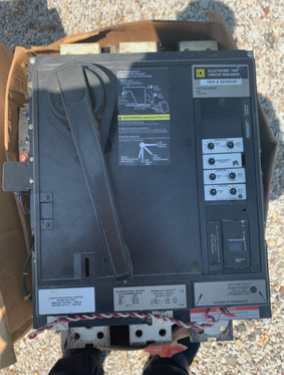
Sell Circuit Breakers With Electronic Trip Units
Send trip-unit models, sensors, rating plugs, and breaker data after calling 713-385-1333.
Electronic trip units can change the identity and application of a breaker. Provide the trip-unit manufacturer, model, sensor rating, rating plug, long-time, short-time, instantaneous, and ground-fault functions when shown. Photograph the display, adjustment area, connector, labels, and any error or damage.
Do not assume that two breakers with the same frame have the same protection package. One may include ground-fault functions while another does not. A missing trip unit, sensor, plug, or protective module can materially change the commercial review.
If you sell circuit breakers with electronic trip systems, disclose whether the breaker and trip unit were tested together. Provide dated reports that match serial numbers when available. If no current test exists, identify the equipment as untested.
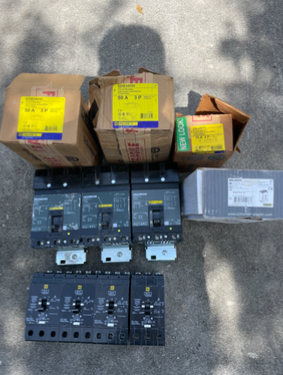
Sell Circuit Breakers in Draw-Out Designs
Request a draw-out breaker review at 713-385-1333.
Draw-out breakers require information about the breaker and its relationship to the cell or cradle. Submit the manufacturer, type, frame, current rating, voltage, interrupting rating, trip unit, control voltage, racking mechanism, primary disconnects, secondary contacts, accessories, and included cradle.
Photograph the front, back, underside, wheels, rails, racking parts, primary stabs, secondary plug, charging mechanism, trip unit, labels, and damage. If the breaker came from switchgear, include the lineup and cell information even when those components are not part of the sale.
When you sell circuit breakers in draw-out configurations, retain racking handles, charging handles, plugs, cradles, extension rails, and documentation. Proprietary parts can be difficult to replace after they are separated.
Sell Circuit Breakers in Air-Breaker Configurations
Call 713-385-1333 with air-breaker ratings, controls, accessories, and condition.
Air circuit breakers can contain stored-energy mechanisms, control-power components, closing coils, trip coils, auxiliary contacts, motors, racking systems, and electronic protection. Identify the control voltage and accessory configuration in addition to the primary electrical ratings.
State whether the mechanism charges, closes, trips, resets, and racks, but never operate equipment unless qualified personnel can do so safely. Manual handle movement is not the same as a complete electrical or mechanical test. Photograph damaged contacts, corrosion, burned areas, missing covers, and incomplete control wiring.
Facilities that sell circuit breakers removed from older switchgear should preserve drawings and section information. Those records can help explain the breaker’s application and compatibility without claiming that the equipment is suitable for a future installation.
Sell Circuit Breakers That Are Obsolete or Discontinued
Have older replacement breakers? Call or text 713-385-1333 for a model-specific review.
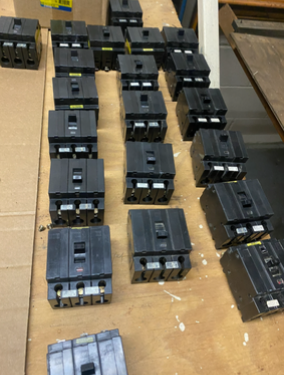
An obsolete designation does not establish value. Some discontinued breakers remain in demand because matching switchboards and industrial systems are still operating. Other products have little marketability because replacement designs, code requirements, technology, parts support, or safety expectations have changed.
For older equipment, photograph every tag, casting, catalog number, frame, trip system, terminal, contact, mounting point, and accessory. Disclose outdoor storage, moisture, corrosion, dust, contamination, seized mechanisms, missing components, and uncertain testing.
The best way to sell circuit breakers that are obsolete is to provide exact identification and let current demand guide the review. Original purchase price and age alone do not establish present value.
Sell Circuit Breakers From Project Overages
Submit boxed and unused project breakers at 713-385-1333.
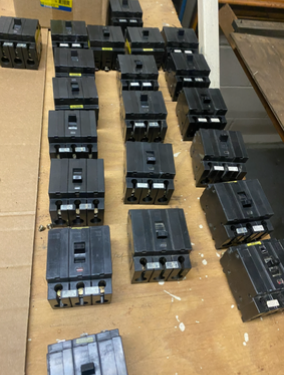
Project overages can result from design changes, cancelled work, excess ordering, substituted equipment, or return restrictions. Original packaging, factory labels, complete accessories, and dry storage help document the inventory. Photograph the box and the breaker to verify that their catalog numbers match.
Disclose opened packaging, damaged cartons, broken seals, shelf wear, missing parts, moisture, or uncertain storage. Do not place a used breaker in a new box or rely solely on the package label. Accurate representation protects the seller and buyer.
Contractors who sell circuit breakers in matching quantities should provide counts by exact model and condition. A spreadsheet can separate sealed boxes, opened boxes, loose unused units, and installed equipment.
Sell Circuit Breakers From Plants and Warehouses
Call or text 713-385-1333 about storerooms, pallets, spare parts, and closure inventories.
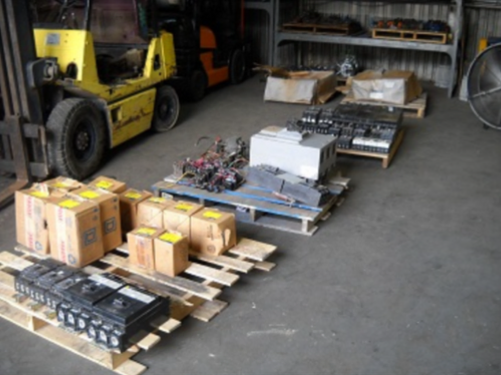
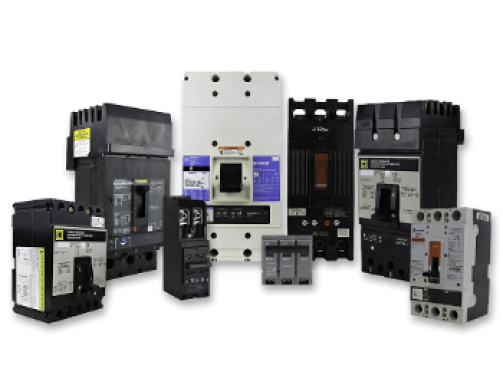
Plant and warehouse inventories may contain many manufacturers, vintages, ratings, and conditions. Assign shelf, pallet, or room numbers and connect those locations to the inventory spreadsheet. Show wide photographs of storage and close images of representative labels and condition.
Separate breakers that are new, used, rebuilt, untested, damaged, incomplete, and unidentified. Do not combine all conditions into one total. Identify property that is leased, customer-owned, financed, disputed, or excluded from the sale before an offer is accepted.
When facilities sell circuit breakers under a closure deadline, loading information becomes critical. Provide pallet counts, approximate weights, forklift and dock availability, gate access, working hours, security procedures, and the last possible removal date.
When It Makes Sense to Sell Circuit Breakers
Breaker inventory should be reviewed before it becomes wet, corroded, mixed, dismantled, or separated from labels and accessories. Early action preserves information and gives the seller time to compare a direct purchase with other disposition options.
Common reasons to sell circuit breakers include:
- Electrical service upgrades and switchgear replacements
- Completed, redesigned, or cancelled construction projects
- Plant shutdowns and facility decommissioning
- Maintenance storeroom reductions
- Distributor and contractor inventory adjustments
- Warehouse consolidation or relocation
- Retirement of equipment that required dedicated spares
- Property turnover, demolition, or lease deadlines
How to Sell Circuit Breakers to Texas Global Resources
1. Send a Representative Submission
Start with manufacturers, several model photographs, estimated quantities, condition, pickup location, and deadline. The preliminary review establishes whether the inventory fits the purchasing focus.
2. Complete the Catalog-Level Inventory
Record catalog numbers, frames, trip ratings, voltage, poles, interrupting ratings, trip units, mounting, accessories, quantities, and condition. Match photographs to list items.
3. Confirm Ownership and Loading Access
The seller must have authority to transfer the equipment. Disclose liens, financing, leases, customer-owned property, and exclusions. Provide forklift, dock, gate, security, and schedule details.
4. Review the Written Purchase Offer
The agreement should identify accepted breaker groups, price, payment, packing, loading, transportation, timeline, and excluded property. Correct quantities and catalog numbers before signing.
5. Verify Payment Before Release
Texas Global Resources states that payment is made before purchased equipment is loaded. Verify cleared funds independently and confirm the authorized carrier and pickup list.
What Affects Value When You Sell Circuit Breakers?
Exact Product Identity
Manufacturer, catalog number, frame, trip, voltage, interrupting rating, poles, mounting, and accessories establish compatibility. Missing information increases uncertainty.
Condition and Completeness
New, unused, used, rebuilt, tested, untested, damaged, and incomplete breakers have different risks. Missing trip units, rating plugs, cradles, lugs, covers, or hardware may affect marketability.
Testing Documentation
Dated reports should match the specific equipment. Visual inspection and prior operation do not equal a current electrical test. Unsupported claims should be avoided.
Quantity and Organization
Matching documented groups can be reviewed and transported more efficiently than mixed unidentified pallets. Accurate counts reduce transaction disputes.
Current Demand
Demand depends on installed systems, replacement availability, parts support, codes, and technology. Original invoice cost is not current market value.
Location and Logistics
Distance, packaging, pallet weight, dock access, forklift availability, work hours, and deadlines affect the overall offer.
Preparation Checklist to Sell Circuit Breakers
- Sort breakers by manufacturer and complete catalog number.
- Separate conditions instead of combining everything into one count.
- Photograph all labels, trip units, connections, and mounting details.
- Keep cradles, plugs, lugs, hardware, and accessories together.
- Protect equipment from water, contamination, and impact.
- Preserve test reports, manuals, drawings, and packaging.
- Identify excluded, financed, leased, or customer-owned property.
- Use qualified personnel to remove breakers from electrical systems.
- Prepare safe loading access and disclose the deadline.
- Verify payment before releasing accepted equipment.
Why Choose Texas Global Resources to Sell Circuit Breakers?
Texas Global Resources offers a direct purchase route for surplus breaker owners. The company reviews submitted equipment, provides offers for accepted inventory, coordinates transportation, and states that sellers are paid before loading. One breaker, matching groups, or larger mixed collections can be submitted.
Texas Global Resources is based in South Houston, Texas and reviews breaker opportunities from sellers across the United States. Purchase feasibility depends on manufacturer, model, ratings, condition, testing, quantity, demand, location, and transportation. Learn more on the Texas Global Resources About page.
Businesses choosing where to sell circuit breakers should expect exact identification, written terms, honest condition review, clear logistics, and a verifiable payment process. Texas Global Resources evaluates the actual inventory instead of offering unsupported blanket pricing.
Sell Circuit Breakers: Seller Questions
Can I sell a single breaker?
A single significant breaker can be submitted. Feasibility depends on model, ratings, condition, location, demand, and transportation.
Can I sell used or obsolete breakers?
Yes. Used and obsolete units can be reviewed. Exact catalog data and an honest condition description are essential because demand varies by model.
Do the breakers need to be tested?
Not always. Untested equipment may be considered, but the testing limitation must be disclosed. Never present previous service as a current test.
Can damaged breakers be included?
Damaged or incomplete units may be identified, but they can have limited value. Photograph cracks, burns, corrosion, broken connections, and missing components.
Who handles transportation?
Texas Global Resources states that transportation is coordinated for purchased breakers. Written terms should define packaging, palletizing, loading, and pickup.
When will payment be provided?
The company states that payment occurs before accepted equipment is loaded. Confirm the method in writing and independently verify funds.
Request an Offer to Sell Circuit Breakers
Do not wait until breaker labels fade, accessories disappear, moisture causes damage, or a facility deadline forces a rushed decision. A timely submission preserves the information required for a commercial review.
To sell circuit breakers, send clear photographs, manufacturers, catalog numbers, ratings, trip units, mounting details, quantities, condition, testing information, pickup location, and the requested schedule. Texas Global Resources can determine whether the inventory fits its purchasing scope.
Call or text 713-385-1333 to sell circuit breakers, or submit your breaker inventory online.